
NOTEArchived at v0.1 (2026-08-07) — frozen, not actively maintained. This design is retired from active CI to save render cycles. To improve it, fork the repo, update it against current CI, and contribute it back as a derivative per the repo's lineage tracking (see also CLAUDE.md → "Archived designs").
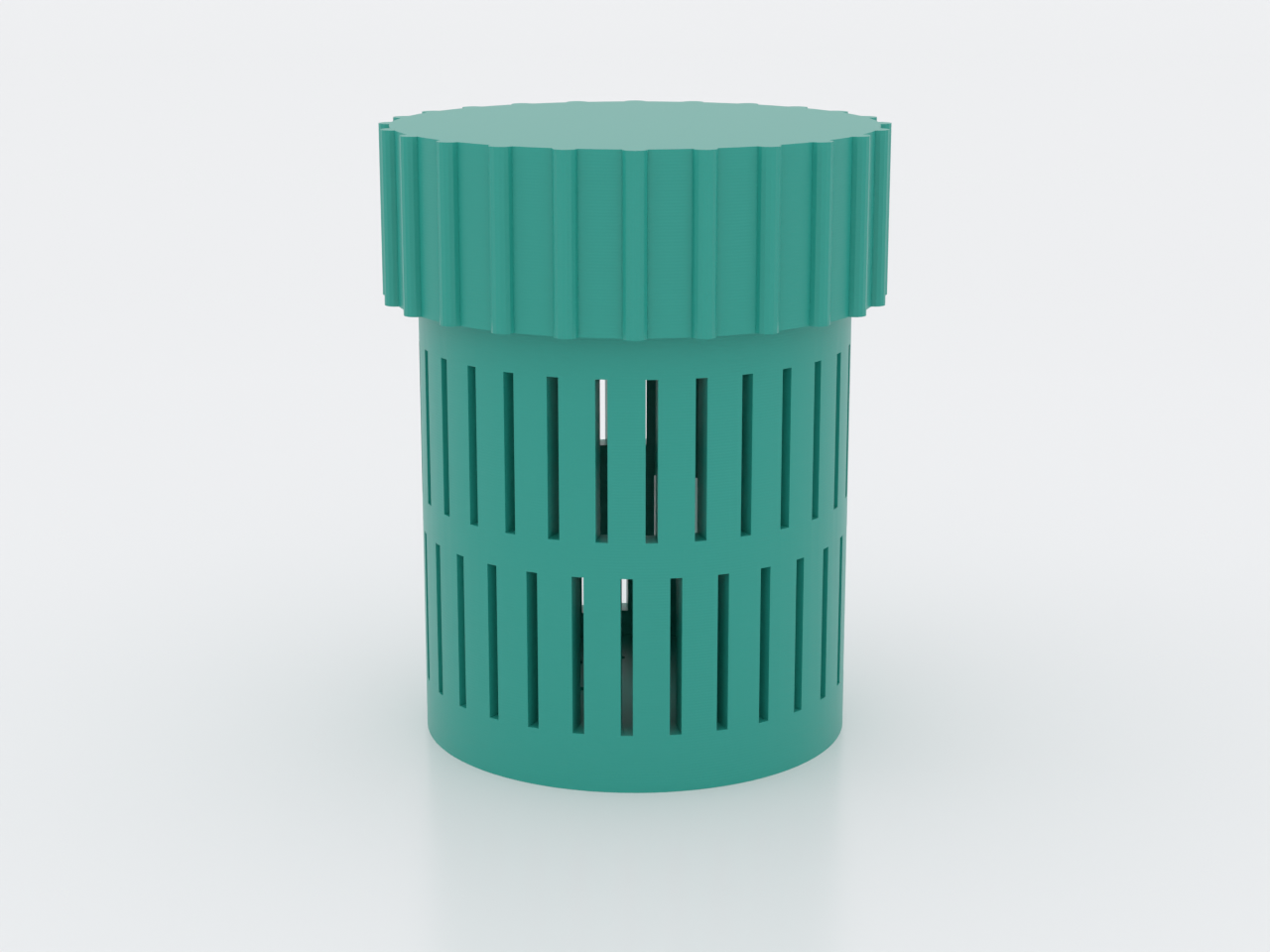
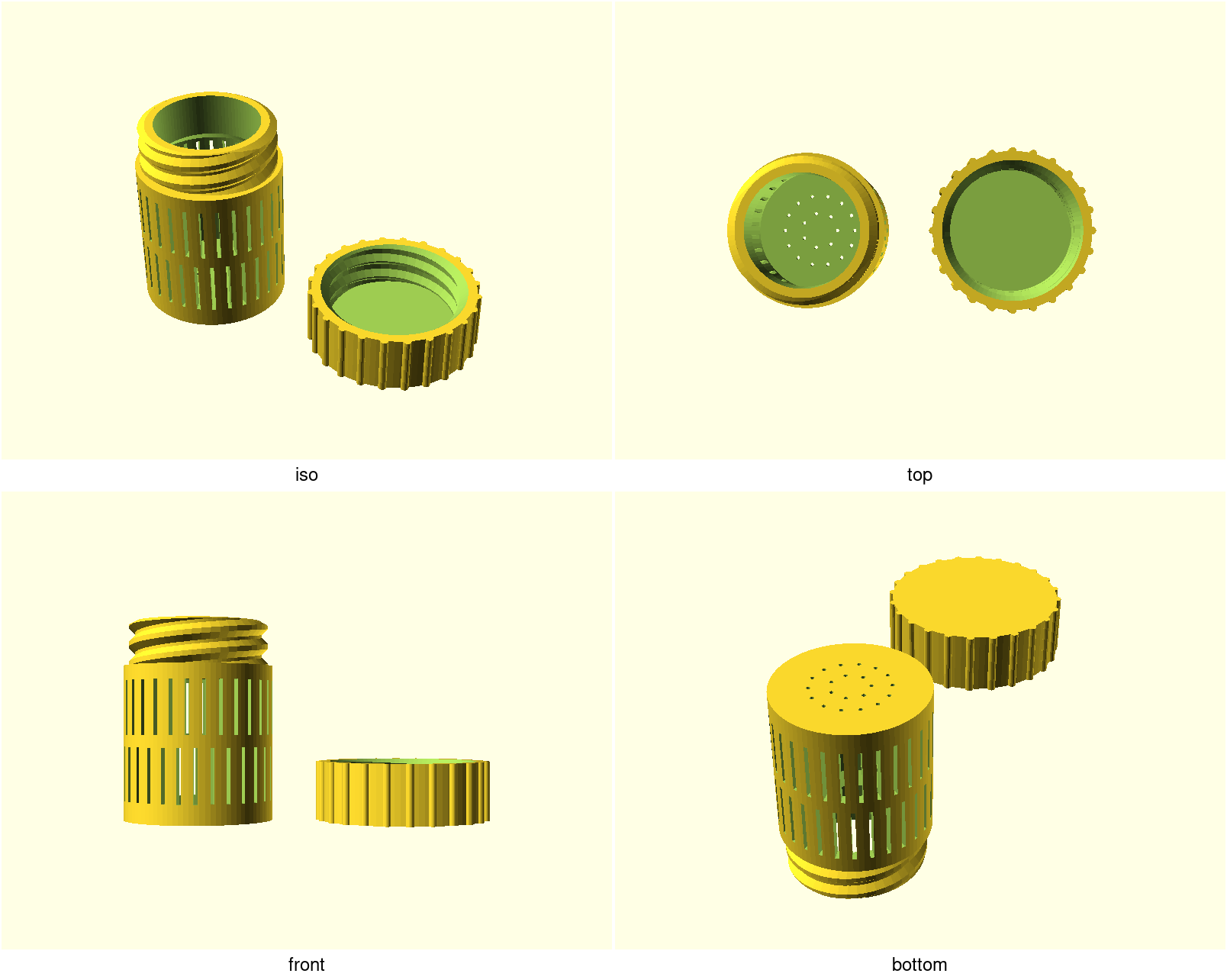
Refillable two-part screw capsule for loose silica gel beads in filament dry-boxes. The perforated body lets air and moisture reach the beads, and the lid screws on with real trapezoidal threads and a ribbed grip edge — easy to open even with dry-box gloves on. Both parts print support-free on FDM, with vents sized for a standard 0.4 mm nozzle.
What you get
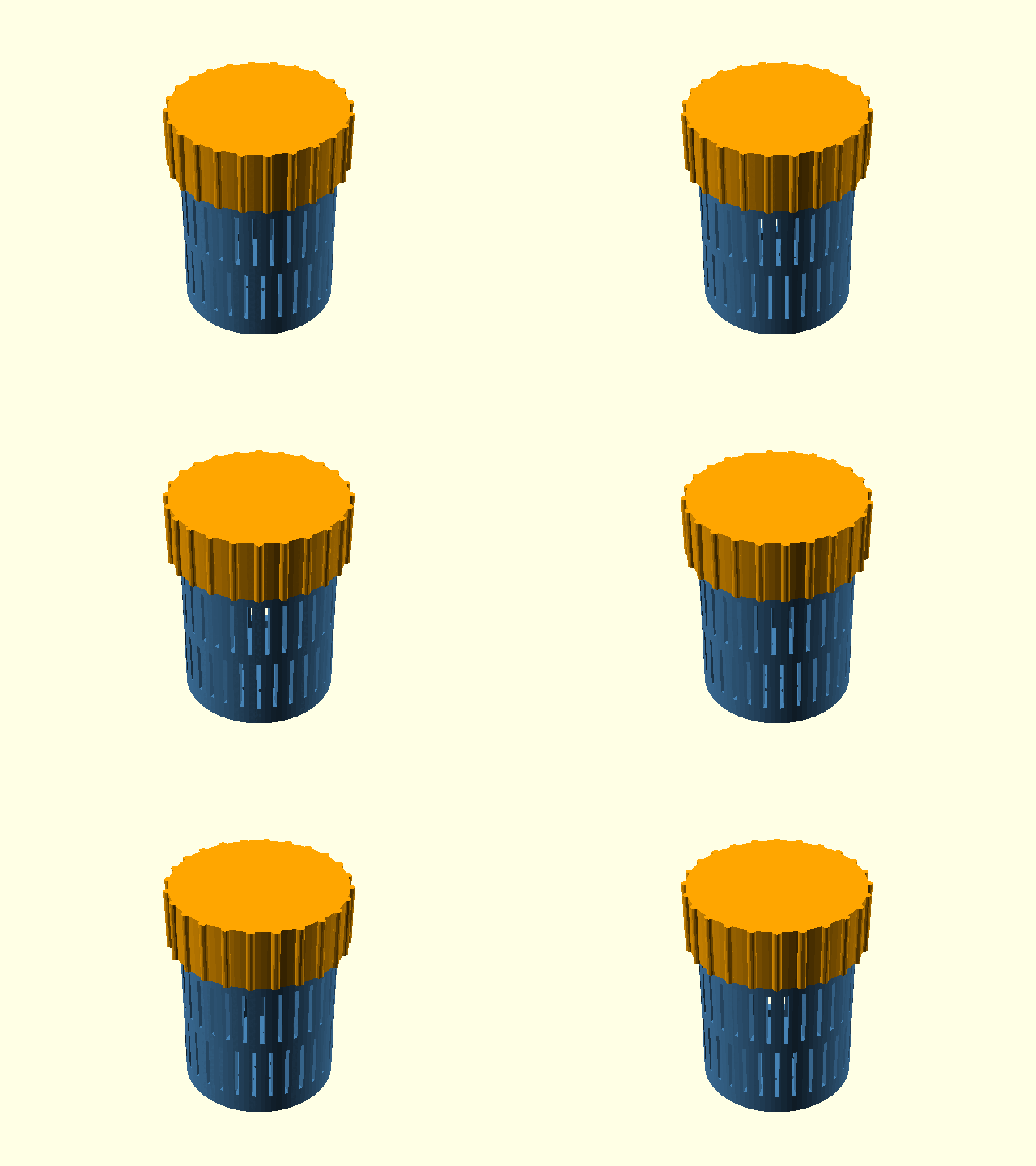
One .scad file that generates both parts. With the default
part = "print", both are laid out side by side on one plate, ready to
slice; body, lid, assembly, and cutaway are also available.
- Body — perforated cylinder with a threaded neck, ~30 mm outer diameter × ~40 mm tall. Vertical slot vents (0.8 mm wide, 2.4 mm webs) plus a perforated floor; every opening is sized to retain a worn 1 mm indicating-silica bead, and the render fails with a clear message if you widen the vents past that limit.
- Lid — screw-on cap with internal threads, a lead-in chamfer, and 24 grip ribs (~35 mm across the ribs). Two-start, 4 mm-pitch threads mean it opens in about one turn.
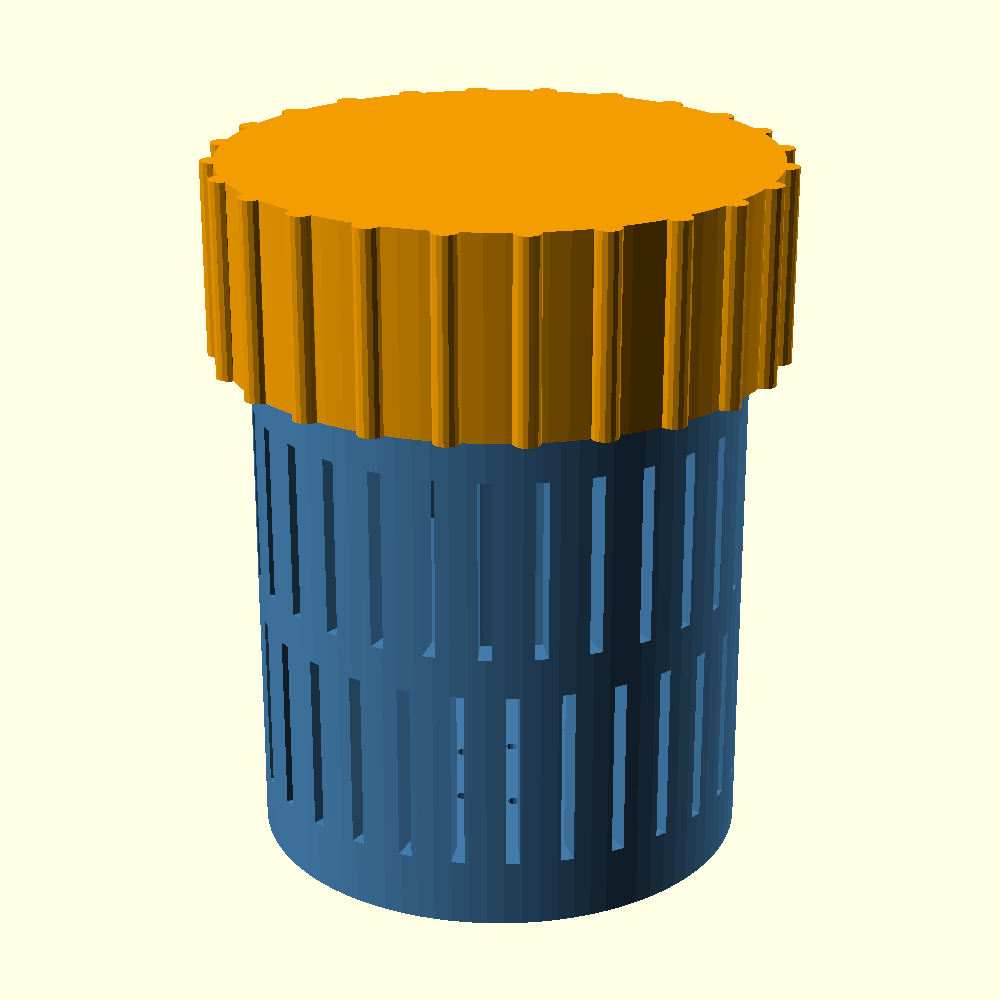
Closed up, the capsule is ~35 mm across the ribs × ~43 mm tall — handy
when sizing a dry-box slot; the .scad echoes the exact values
(35.0 mm and 42.8 mm at the defaults) at render time.
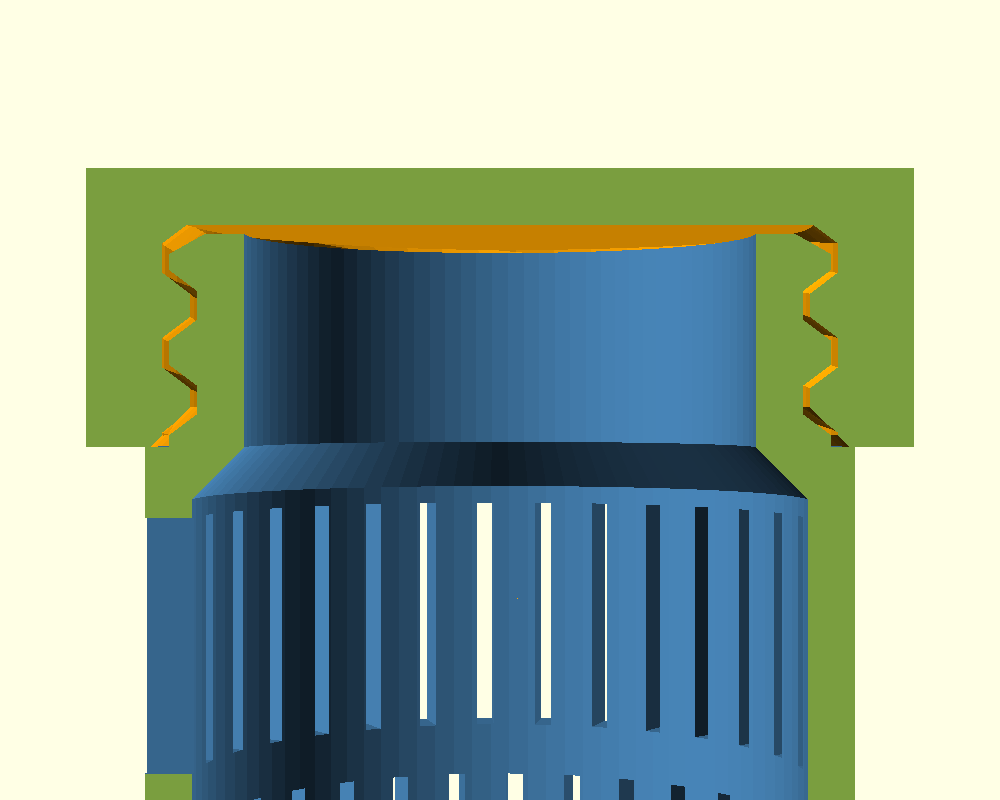
| Closed assembly | Section through the thread zone |
|---|---|
 |  |
Print settings
- Material: PLA or PETG. If you regenerate the silica in a warm oven with the beads still inside the capsule, use PETG (or empty the beads out first).
- Layer height: 0.2 mm works well — the 45° thread flanks and vertical slot vents print cleanly at standard layer heights; finer layers just cost time.
- Infill: doesn't matter here — the part is nearly all walls, floor, and threads, so any default is fine.
- Supports: none needed, on either part. Thread flanks are 45°, the body's internal shoulder is a 45° cone, and each slot vent bridges only its own 0.8 mm width.
- Orientation: as generated. The body prints upright on its floor;
part = "lid"(and the default"print"layout) already outputs the lid flipped — flat top on the bed, internal threads up a vertical bore. - Nozzle: the default 0.8 mm slot vents are chosen to print crisply on a standard 0.4 mm nozzle; the optional hex vents tend to seal shut at sub-1 mm sizes, so keep them for coarser beads.
Parameters
The ones you're most likely to touch:
| Parameter | Default | What it does |
|---|---|---|
part | "print" | Geometry to generate: body, lid, print (both, sliceable), assembly, cutaway |
thread_tol | 0.3 mm | Radial clearance on the female thread — the fit-tuning knob (see below) |
body_od | 30 mm | Body outer diameter |
body_h | 40 mm | Overall body height, including the threaded neck |
vent_style | "slot" | slot (default) or hex vents on the side wall |
vent_w | 0.8 mm | Max vent opening size; guarded against bead_min |
bead_min | 1.0 mm | Smallest bead the capsule must retain (1.0 = indicating silica gel, 1–3 mm grade) |
floor_vents | true | Perforate the floor as well |
All parameters are at the top of desiccant-capsule.scad, grouped in
Customizer sections; override on the command line with
-D 'thread_tol=0.4'.
Assembly & use
Print both parts, fill the body with silica gel through the neck, and screw the lid down until its rim seats on the body shoulder — that shoulder is a positive stop, so you can't overtighten into the threads. Drop the capsule into your dry-box and swap or regenerate the beads whenever your indicating silica changes color.
Dialing in the thread fit: thread clearance is one number,
thread_tol (default 0.3 mm), and it applies equally at crests, roots,
and flanks. If the lid binds, increase it in steps of 0.1 and reprint
the lid only (part = "lid"); if the lid feels sloppy, decrease it
by 0.1. The body never needs reprinting to fix the fit.
Design rationale — the thread-clearance derivation, bead-containment guards, and vent open-area accounting — lives in NOTES.md.