NOTEArchived at v0.1 (2026-08-07) — frozen, not actively maintained. This design is retired from active CI to save render cycles. To improve it, fork the repo, update it against current CI, and contribute it back as a derivative per the repo's lineage tracking (see also CLAUDE.md → "Archived designs"). It was frozen before it was ever printed or physically validated (see the work-in-progress note below), so its geometry is unproven — a revival should start there.
Superseded joint — this kit does not interoperate with
nuggstoday. As of 2026-08-03, N.U.G.G.S. is a system with one genderless interlock standard, and it isnuggs's quarter-turn port. This design's gendered lap-skirt joint is superseded by it: a Yard module and anuggsmodule will not mate, in either direction. A rebuild onto the shared port — as open modules with a round arc floor, not flat troughs — is planned as its own PR. Until it lands, treat the two kits as separate. The welfare length rule quoted below has also been re-attributed and re-scoped; the corrected version lives indesigns/nuggs/PM.md(N2) anddocs/nuggs-research.md§11.
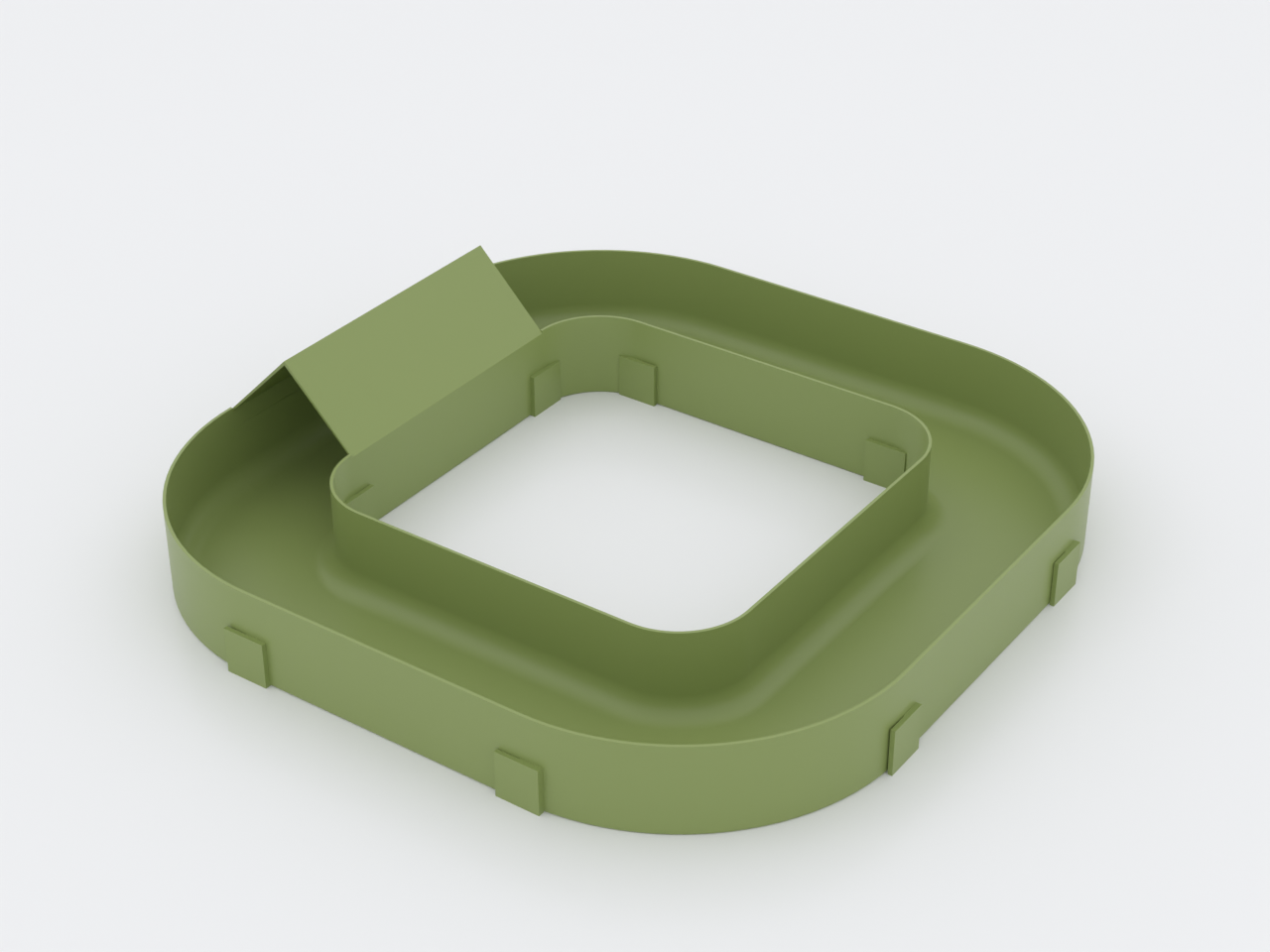
An open-top playpen run for an adult Syrian hamster: turns, branches, a covered hide, and a closed circuit with no dead ends in it anywhere. It is a kit of modules you lay out on the floor of a playpen during free-roam time — not a tube system, and nothing goes in the cage.
Work in progress — nothing here has been printed yet. All six parts pass
gate.sh --sliceat 100/100 and the covered segment's bore is measured on the exported mesh, not just asserted. What no one has checked is how the joint behaves in plastic:joint_tol = 0.30is a starting guess, so print the coupon first. Design request: issue #73.NOTES.mdhas the decisions and the open items.
Why this one is open at the top
The sibling design nuggs is an enclosed tunnel, and its
product page leads with an uncomfortable fact: the expert consensus (PLOS
One 2022 EXOPET-II; TVT Merkblatt 62) is that hamster tube systems should
not exist. They cannot be ventilated, they condense, they cannot be
cleaned, and a long tube is somewhere an animal can get stuck and cannot be
reached. Those objections are why nuggs is short and straight — and why it
refuses exactly the loops and branches this design is built from.
Take the roof off and most of those objections stop applying, because every one of them is a consequence of enclosure:
| Objection to tube systems | An open-top run |
|---|---|
| Length limit — he cannot reverse, you cannot reach him | He steps out anywhere along it. So does your hand |
| Cannot be ventilated, condenses | Nothing encloses air |
| Cannot be cleaned | It is a trough. Lift a module out and wash it |
| Dead ends trap and stress | A closed circuit has no terminus at all |
| Eats cage floor and substrate | Lives in the playpen, not the cage. Zero substrate cost |
What does not change is anything about the animal's body. Wherever this design puts a roof on — the refuge — the full 70 mm bore floor applies, and the whole run is flat, because Syrians climb well but have almost no depth perception and will walk off a raised edge.
"Loop" here means a closed circuit, not a loop-the-loop. Twists, switchbacks, S-bends, spurs and figure-eights are all fine. A helix, a spiral ramp or a vertical loop is refused by the model.
What you get
Six parts from one .scad. Every module is 80 mm wide inside with a flat
floor, prints flat on the bed, and needs no supports.
| Part | Size (mm) | Filament | Time |
|---|---|---|---|
straight | 172.0 × 88.6 × 48.6 | 62.11 g | 5h 14m |
curve90 | 124.3 × 133.6 × 48.6 | 49.49 g | 4h 18m |
curve45 | 97.1 × 98.0 × 48.6 | 26.65 g | 2h 27m |
wye | 183.3 × 165.6 × 48.6 | 76.28 g | 6h 40m |
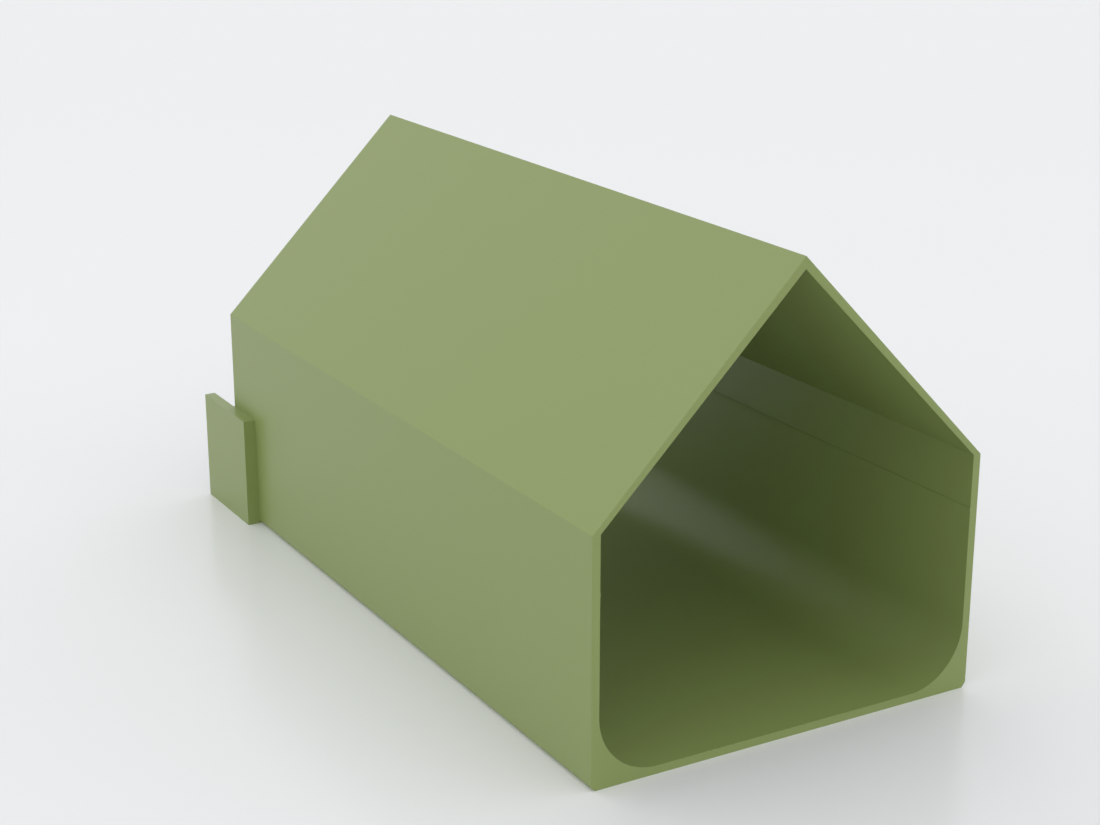
refuge (covered) | 172.0 × 88.6 × 89.3 | 91.89 g | 7h 18m |
nuggs-yard-coupon | 57.0 × 208.8 × 48.6 | 40.40 g | 3h 39m |
Masses and times are the gate's own PrusaSlicer test-slice at 0.2 mm / 0.4 nozzle, PLA at 1.24 g/cm³. PETG is about 2.4% heavier.
The refuge is the one covered part, and it is where the welfare numbers bite. Its roof is a 45° gable rather than an arch so both slopes print without support, and the measured inscribed circle through it is 70.75 mm — checked on the exported mesh at six stations along its length, not merely asserted in the source.
A wye is the same 160 mm face-to-face as a straight, so it drops into
any layout in place of one.
Suggested builds
Pick one to suit your spool. Print the coupon (40 g) before any of them.
| Build | Parts | Filament | Footprint |
|---|---|---|---|
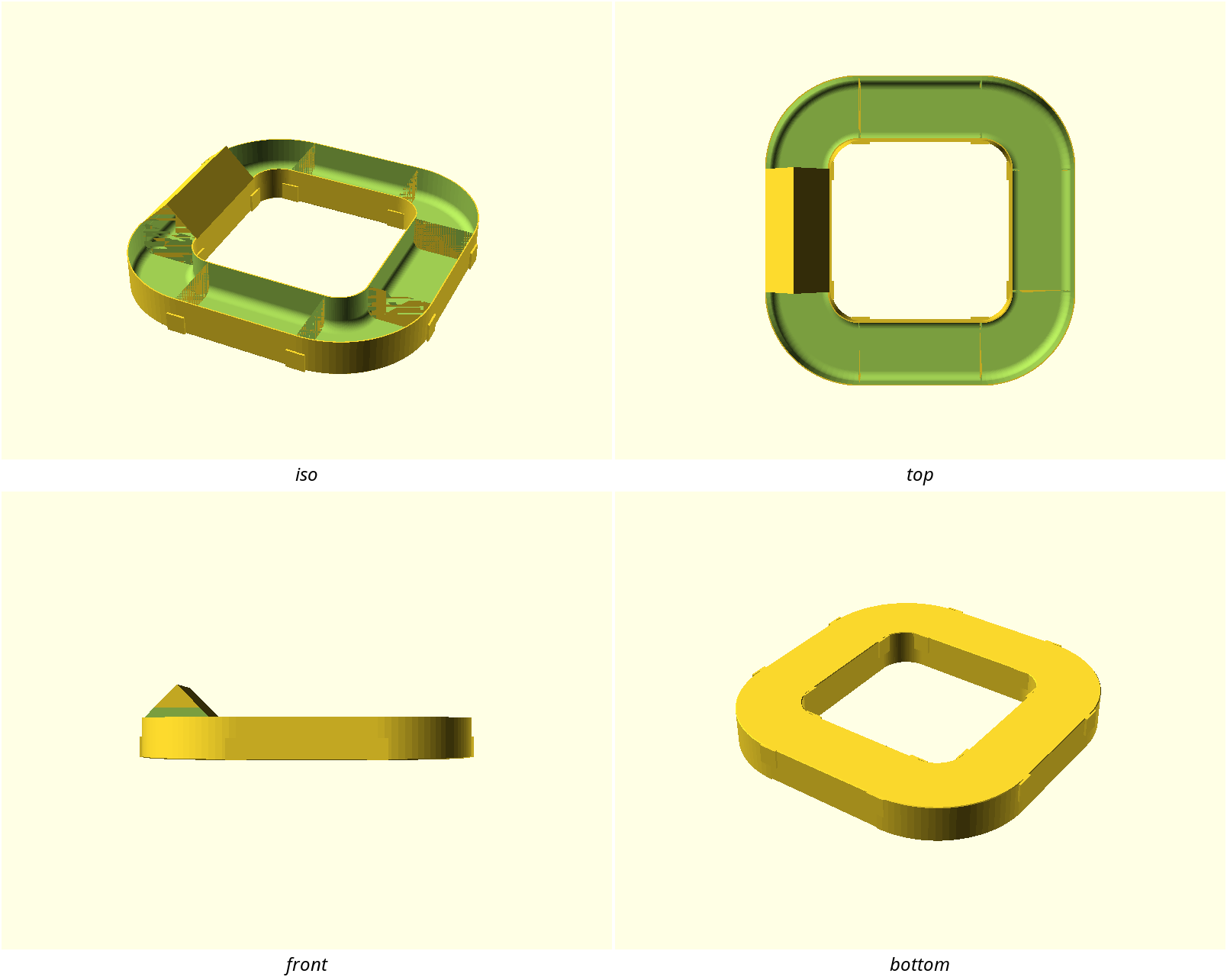
| Oval + branch ⭐ | 4 × curve90, 1 × wye, 1 × refuge | 366 g | ~406 × 246 mm |
| Oval circuit | 4 × curve90, 1 × straight, 1 × refuge | 352 g | ~406 × 246 mm |
| Square circuit | 4 × curve90, 3 × straight, 1 × refuge | 476 g | ~409 × 409 mm |
| Open S-run (no circuit) | 2 × curve90, 2 × straight | 223 g | fits anything |
Totals are summed from the gate's unrounded figures and then rounded once, so adding up the rounded per-part masses above can land a gram out.
The starred build is the recommendation: it has the loop, the branch and the hide, and lands at 407 g including the coupon.
Shorter run, more stops. The evidence base for hamster welfare (Hauzenberger et al. 2006) puts substrate depth and foraging — not tunnel length — at the centre of enrichment. A 2 m circuit of bare channel is a corridor; a 1.2 m circuit with things to do on it is a foraging route. Scatter feed along the run and stand a shallow ceramic dish of sand beside it. That costs 0 g of filament and does more than another metre of channel.
Print settings
- Material: PLA or PETG. PETG is the welfare-safer answer for the same
reason as
nuggs(its glass transition is well above any wash you would give it), PLA is cheaper and easier and changesjoint_tolslightly. - Layer height: 0.2 mm
- Perimeters: 4 (fills the 1.6 mm wall)
- Infill: 20%
- Supports: none — for any part. The steepest downward-facing surface in the whole kit is the refuge's 45° gable.
- Orientation: exactly as each part renders — flat on the bed; printcheck reports "current orientation is as good as any axis-aligned alternative" for all six.
- Brim: not needed. Every module has a full flat footprint (unlike the
nuggsstraight, which stands 160 mm tall on a 2.4 mm ring and does). - Plate: a
straightis 88.6 mm wide, so two fit side by side on a 256 mm bed (three would need 266 mm). A 350 mm-class bed takes three.
Cleaning: hand wash, ≤ 50 °C, unscented mild dish soap, dry fully. Never a dishwasher — the heated dry cycle exceeds even PETG, and a deformed covered segment is a narrowed one.
Parameters
| Parameter | Default | What it does |
|---|---|---|
joint_tol | 0.30 mm | The one fit knob. Clearance between a skirt and the wall it laps. Tune on the coupon in ±0.05 steps |
inner_w | 80 mm | Internal floor width. Asserted ≥ min_run_width |
min_run_width | 80 mm | Welfare floor for the open run's width, and what inner_w is asserted against. Lower it and the guard moves with it |
side_h | 47 mm | Sidewall height. Set by the refuge, not the open run — it is the smallest value at which a covered segment still clears the 70 mm bore floor. At 45 mm the refuge measures 69.1 mm and is non-compliant |
min_covered_bore | 70 mm | Welfare floor for any covered segment. Never lower it |
body_len_mm | 180 mm | Your animal's head-and-body length; caps refuge_len at 2× it |
straight_len | 160 mm | Face-to-face module length; wye_len and refuge_len match it so modules interchange |
curve_r | 80 mm | Curve centreline radius. Bigger sweeps are gentler and cost more |
wall | 1.6 mm | Shell thickness; 4 perimeters at a 0.4 mm nozzle |
wye_junction | 50 mm | Where the branch leaves the main run. Moving it forward thins the crotch — asserted |
All parameters are at the top of nuggs-yard.scad, grouped in Customizer
sections; override on the command line with -D 'curve_r=100'.
Assembly & use
Modules simply sit on the pen floor. Each has skirts at one end and a bare end at the other: slide a skirted end over the neighbour's bare end. Keep every module facing the same way round the circuit and any module mates with any other.
To take a module out — for cleaning, or because you want the layout different — lift it straight up. The skirts wrap the sidewalls only and never pass under the neighbour's floor, so nothing has to be slid along the run to free one piece in the middle.
Print this first
nuggs-yard-coupon.scad gives you two 45 mm stubs for 40 g. Mate them:
- Rocks or falls off → lower
joint_tolby 0.05 and reprint. - Will not seat, or the skirt splays → raise it by 0.05.
Do not commit 92 g to a refuge before a stub mates cleanly.
Layout rules the model cannot check for you
- No dead ends. Close the circuit, or leave a spur ending in open channel he can turn around in and step out of. Never point a spur into a corner he can be cornered in.
- Keep it flat. Do not prop, stack or ramp any module. The whole design assumes level ground.
- One covered segment per run, and keep it short. The refuge is the only roofed part and it is sized to the 2 × body-length budget on its own. Coupling two refuges end to end doubles the enclosed length and breaks it.
- Supervised free-roam only. This is playpen furniture, not housing.