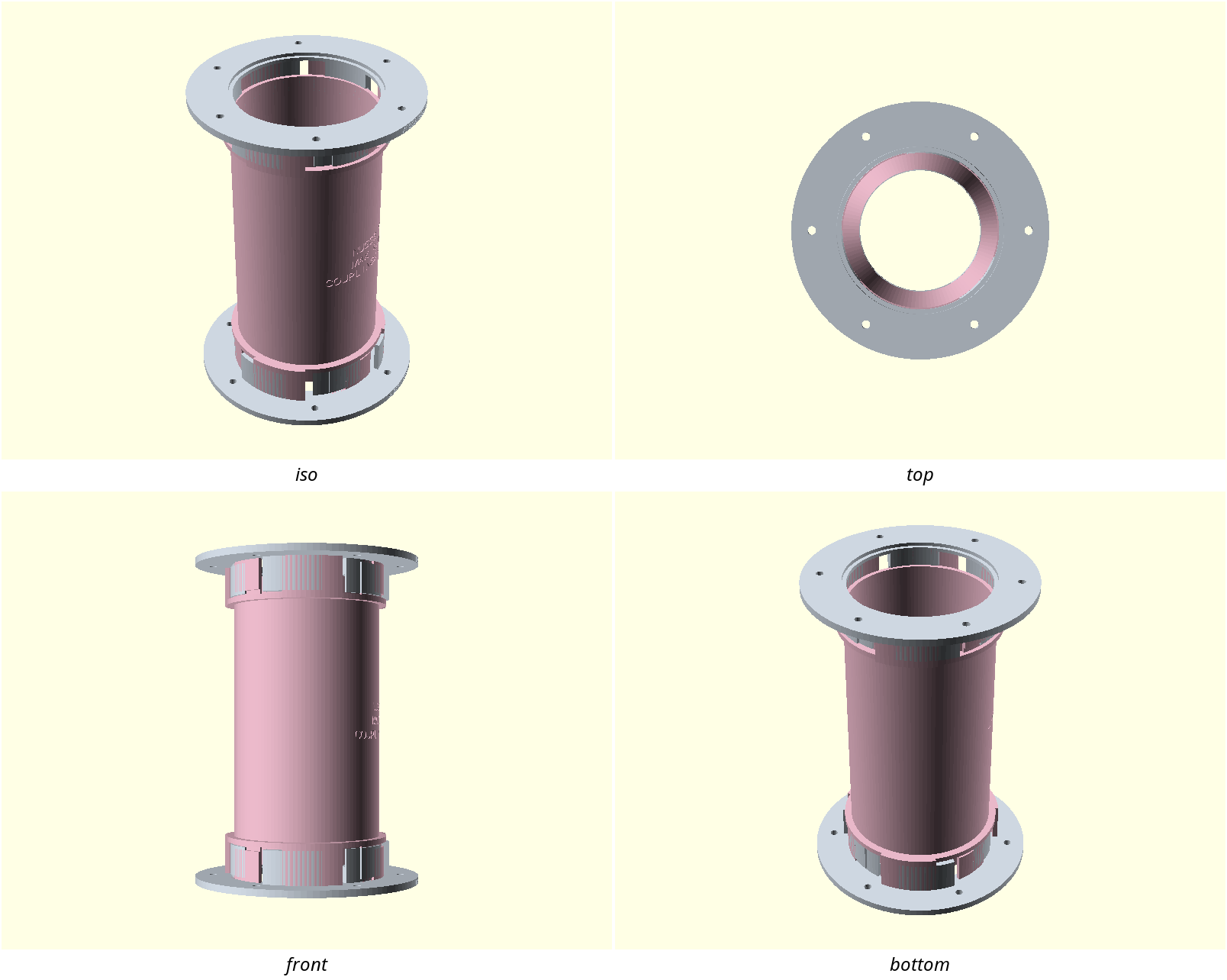
NOTEArchived at v0.1 (2026-08-07) — frozen, not actively maintained. This design is retired from active CI to save render cycles. To improve it, fork the repo, update it against current CI, and contribute it back as a derivative per the repo's lineage tracking (see also CLAUDE.md → "Archived designs"). It was frozen before it was ever printed or physically validated (see the work-in-progress note below), so its geometry is unproven — a revival should start there.
An 80 mm-bore tunnel system for an adult Syrian hamster whose factory cage tubes are too narrow for a pouch-full animal. The system is really one thing: a genderless quarter-turn port. Every module carries the same port at every end, so any module mates with any other either way round, and the whole run comes apart in one twist with the animal still inside it. Today the kit that exists is the Bin Bridge — two bulkheads and one straight, joining two enclosures through their walls. Everything else (elbow, node, open module, wye) is backlog, not product.
Work in progress — nothing here has been printed yet. The design passes
gate.sh --slice, and the coupling is verified in geometry: two identical ports nest, twist either way, and resist axial pull. What no one has checked is how it behaves in plastic —port_tol = 0.30is a starting guess, so print the coupon first and expect to tune it. Track progress in issue #34;NOTES.mdhas the open items andPM.mdthe ranked backlog.
Read this before anything else
The expert consensus is that hamster tube systems should not exist. PLOS One 2022 rated them unsuitable as a product category, and the German veterinary welfare association's Merkblatt 62 gives reasons: they cannot be ventilated, they condense, they cannot be cleaned, and clear tube denies a prey animal any refuge.
This design exists to answer each of those individually, or to omit the part. That is why it is short, opaque, open at both ends, and lives between enclosures rather than inside one.
And here is the limit of that claim, stated plainly: we could not retrieve why PLOS One rated tube systems unsuitable — only that it did. So the table below answers the defects we enumerated. It is not a demonstration that this design escapes that paper's verdict. If you are deciding whether to print this, that gap is yours to weigh, and it is the honest reason the page leads with the objection instead of burying it.
| Documented defect | What this does about it |
|---|---|
| Bore too narrow for a pouch-full adult | 80 mm, full-bore through the wall crossing; 70 mm floor as a hard assert |
| Cannot be ventilated / condenses | No closed volumes. Every run is open at both ends into a ventilated enclosure — no caps, no blind branches |
| Cannot be cleaned | One twist releases any module for a hand wash, without disturbing the nest |
| Transparent tube gives no refuge | Opaque, uncoloured filament; you inspect it by it being short and straight |
| Endless tube mazes | No single run of enclosed bore exceeds 2 × your animal's body length — 360 mm at the default. A run ends at an open end, an open module, or a chamber he can turn around in. A bend, a junction, a coupling and a top hatch are not ends (see The length rule). The Bin Bridge is one 246 mm run, and the limit is engraved on the part (MAX RUN 360MM / COUPLINGS DONT RESET) |
| Eats cage floor and substrate | Runs between enclosures at bedding height — zero floor area, zero substrate |
Measure your hamster. body_len_mm defaults to 180 mm and sets the
budget for each enclosed run (not for the system as a whole — see
The length rule).
And min_bore_mm = 70 is not a suggestion. The reason usually given is
that an undersized opening lets grit in a full pouch lacerate the mucosa,
leading to impaction and abscess with no visible symptom until surgery —
and that mechanism is reported rather than verified: it comes from
secondary rescue and veterinary pages, and nobody on this project has read
the primary literature. Treat it as the reason the floor is conservative,
not as a diagnosis.
The floor stays regardless, and the argument for it does not depend on that
mechanism being exactly right: the animal cannot report a bore that is too
narrow, being generous costs a few grams of filament, and being wrong costs
surgery. That asymmetry is why it is an assert and not a preference.
The length rule, and how far to trust it
The one rule you have to hold in your head when you lay out a run. It is also the rule this project got wrong twice, so it comes with its receipts.
The rule. No run of continuously enclosed bore may exceed
2 × body length (360 mm at body_len_mm = 180). A run is the
unbroken stretch of enclosed bore between two breaks, and there are
exactly three breaks:
- an open end — a port discharging into a ventilated enclosure;
- an open module — a bore with a longitudinal window of at least 180°, so the opening is the widest part of the void and the animal lifts straight out;
- a turnaround node — a chamber at least one body length clear inside and itself open to ventilated space (an open top, a ≥ 180° window, or a port into an enclosure). Width alone is not enough: width answers can he turn around, and it says nothing about can the air move. A sealed wide chamber is a dead volume in the middle of a run, which is one of the defects this whole design exists to answer.
What is not a break, and this matters more than the number:
| Not a break | Why |
|---|---|
| A bend | He cannot rotate in an 80 mm bore. A 45° elbow turns the tube, not the animal — he still has to reverse the whole way back |
| A junction at bore diameter | A wye at 80 mm is a branching one-way bore. It multiplies the ways to be trapped, it does not reduce them |
| A coupling | It is a joint. Two straights coupled are one 406 mm run, which is over the limit |
| A top hatch | It resets retrieval — you can reach him. It does not reset reversing — he still cannot turn around. Two different problems, two different fixes |
Why 360 and not some other number. Because he cannot turn around, he leaves by whichever end is nearer — so the worst case is half the run. A 360 mm run bounds worst-case unassisted reversing at 180 mm: one body length. That reasoning is ours, not a published finding. No literature measures how far a hamster will reverse, or the width he needs to fold in.
Where the 2× comes from, corrected. It is the Deutscher Tierschutzbund position paper Tierschutzwidriges Zubehör — not TVT Merkblatt 62, which this project cited for two rounds and which appears never to have published a length limit at all (its objections are qualitative). In the source it is one limb of a conjunctive test: tubes are acceptable only if they are at most twice body length and ensure adequate ventilation. Both limbs, or neither.
How much to trust it. Every source here was reached through search-result summaries under an egress block; nobody on this project has read the primary text. Specifically:
- Probably right: the rule is DTSchB's, not TVT's, and it is conjunctive.
- Least certain, and it is the load-bearing part: that the limit applies per tube rather than to a whole system. That reading is inferred from plural German in a search summary. If it turns out to be per-system, this page's rule is too permissive and the "one straight per run" line becomes "one straight, full stop."
- Two figures that cut the other way, both real: German pet-care sites circulate a stricter 25–30 cm maximum; and wild Syrians work burrow galleries averaging 200 cm and reaching 900 cm, at tunnel diameters of only 40–50 mm (Gattermann et al. 2001) — which is why the 2× figure cannot be read as a biological tolerance. A soil burrow is grippable on all sides, self-ventilating, dug to fit that animal, and escapable by digging. Printed PETG is none of those, which is why we keep the limit anyway.
The full working, with the confidence ladder, is in
docs/nuggs-research.md §11.
What you get
straight— the enclosed run, ⌀96.8 × 180 mm at defaultsbulkhead_in— inner flange + full-bore spigot through an 89 mm wall holebulkhead_out— outer flange + bolt circle; doubles as the drill templatenuggs-coupon— two port stubs; print this first to tune the fit
A complete Bin Bridge is two bulkhead pairs and one straight.
Print settings
- Material: natural (uncoloured) PETG. Not PLA — its glass transition (57–70 °C) overlaps dishwasher temperatures, and a deformed tube is a narrowed tube.
- Layer height: 0.2 mm
- Perimeters: 5 (fills the 2.4 mm wall)
- Infill: 20 %
- Supports: none needed — every downward-facing surface is ≥ 50°
- Orientation: tube axis vertical. This is not a preference: horizontal puts unsupported bore crown inside the tube the animal walks through, and it is also what caps any future bend at 45° per module
- Brim: required,
outer_and_inner, 5 mm. Not optional, and worth understanding: the straight has no flat base — it stands on the six port sector tips, 528 mm² across 69% of the circumference, holding up a 180 mm tall part for ten hours. A brim roughly triples the anchored area, but it does not bridge the gaps between the tips (each is ~17 mm of arc, and a 5 mm brim reaches 5 mm). Use it anyway; also print on a clean, degreased plate, and do not run a draughty room. - You will also need: an 89 mm bi-metal hole saw. It is a stocked size but not in a typical 13-piece set, and there is no way around a hole larger than the bore.
Never drill tempered glass — Detolfs and most tank panels shatter under a hole saw. This design does not serve glass enclosures.
Cleaning: hand wash only, ≤ 50 °C, unscented mild dish soap, rinse and dry fully. Never a dishwasher — the heated dry cycle exceeds even PETG.
Parameters
| Parameter | Default | What it does |
|---|---|---|
bore_d | 80 mm | Internal bore. The headline number; asserted ≥ min_bore_mm |
min_bore_mm | 70 mm | Welfare floor (DTSchB pouch-full entrance minimum). Never lower it |
body_len_mm | 180 mm | Your animal's head-and-body length; sets the enclosed-run budget (2 ×) |
straight_len | 160 mm | Face-to-face run length |
port_tol | 0.30 mm | The one fit knob. A real clearance in millimetres on every coupling surface — radial, axial and circumferential — whatever bore you set. Tune on the coupon in ±0.05 steps |
wall | 2.4 mm | Tube shell; 6 perimeters at a 0.4 mm nozzle |
lug_deg | 40° | Coupling sector width. Also sets first-layer area, since the part stands on these tips — raise it toward 46 for more bed grip, never past pitch/2 − twist_deg |
wall_hole_d | 89 mm | Enclosure-wall hole — a stocked hole-saw size |
twist_deg | 14° | The locking twist. Bounded by rib_deg + twist_deg ≤ lug_deg |
mark_h | 5 mm | Cap height of the engraved revision mark. 0 leaves parts unmarked |
All parameters are at the top of nuggs.scad, grouped in Customizer
sections; override on the command line with -D 'straight_len=120'.
Assembly & use
One straight per run. Never chain two.
This is the one rule the model cannot enforce for you. A run — the continuously enclosed bore between two breaks — must stay within 2 × your animal's head-and-body length. One straight plus both bulkhead throats is 160 + 2×(4+4+25+10) = 246 mm, inside the 360 mm budget at
body_len_mm = 180. (The two 4 mm figures are the bulkhead flange plates. They are bored at full bore, so they are tube the animal walks through, not mounting hardware outside the run — omitting them is what made this read 230 mm until PR #78.) Two straights coupled together is 406 mm and breaks it, because a coupling is not a break — the two tubes are one run. And because every NUGGS face mates with every other, two straights will click together and feel right.assertruns at render time and cannot see what you assemble on the bench, so the rule is engraved on the outside of every straight instead: the port revision (NUGGS PORT R1) plusMAX RUN 360MMandCOUPLINGS DONT RESET. Both engraved lines are derived frombody_len_mm, so they cannot disagree with the assert.If you need a longer bridge, move the enclosures closer or raise
body_len_mmto your measured animal — never add a second straight.
Drill one 89 mm hole in each facing wall, at bedding height, level with each other. Bolt a bulkhead pair into each hole with 6 × M4. Push the straight onto one port, twist 14° to lock — either direction works, the coupling is symmetric — then the same at the other end.
To open a run — for cleaning, or because an animal is in trouble — twist one joint back 14° and lift the straight away. Do not pull the animal.
Markings
Every part that has a face the animal can never reach carries its port revision engraved on it, so you can tell what a printed part conforms to years later — which is the point of there being one port standard rather than several:
| Part | Mark | Where |
|---|---|---|
straight | NUGGS PORT R1 + MAX RUN 360MM + COUPLINGS DONT RESET | outer tube wall, mid-length — in the room, between the enclosures |
bulkhead_out | port revision | flange rim, outside the enclosure wall |
bulkhead_in | (none, deliberately) | every face it has is either inside the enclosure or buried in the wall hole |
The marks are engraved, never raised — a proud character is a
chew-initiation edge. Set mark_h = 0 to omit them.