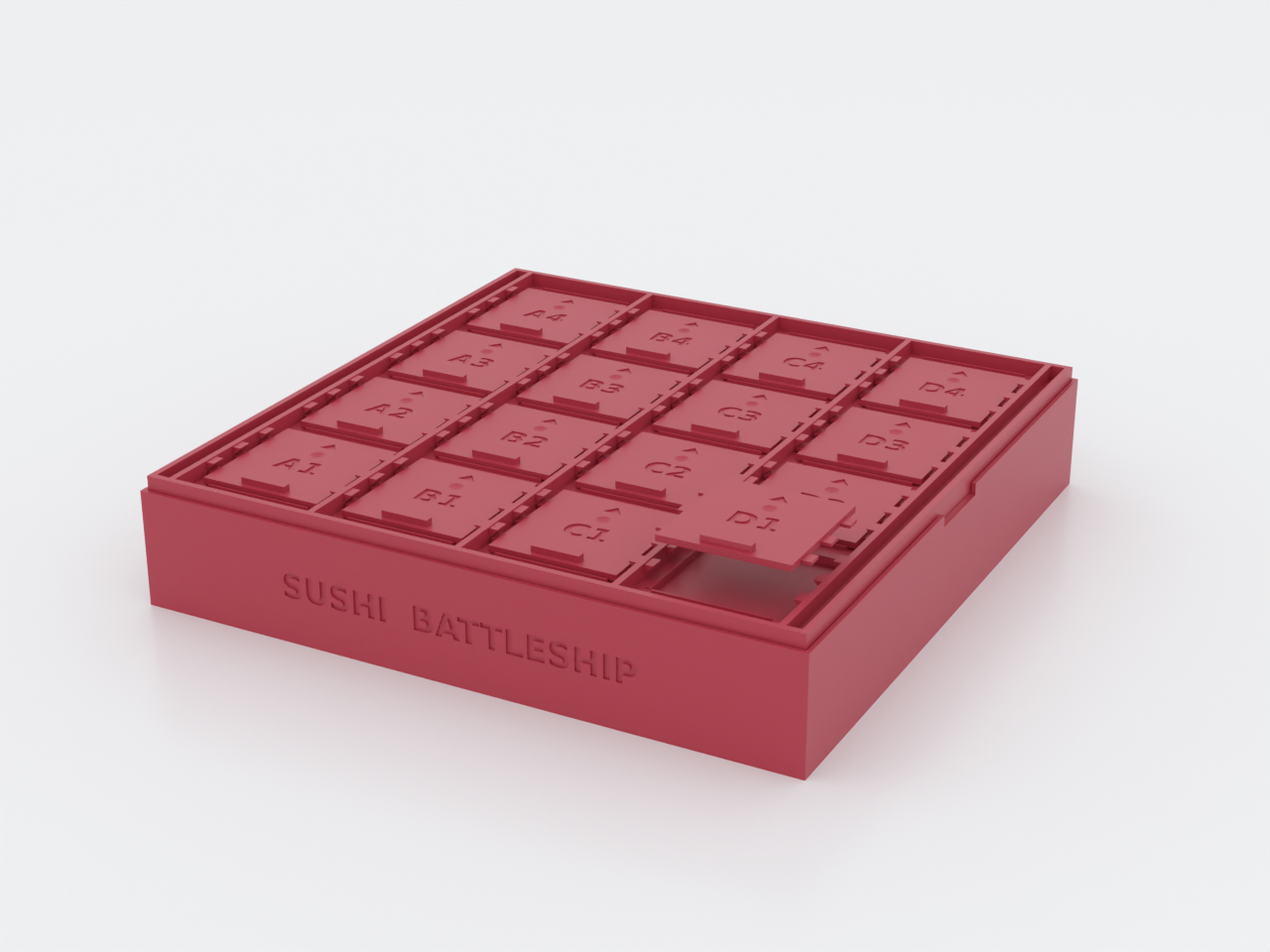
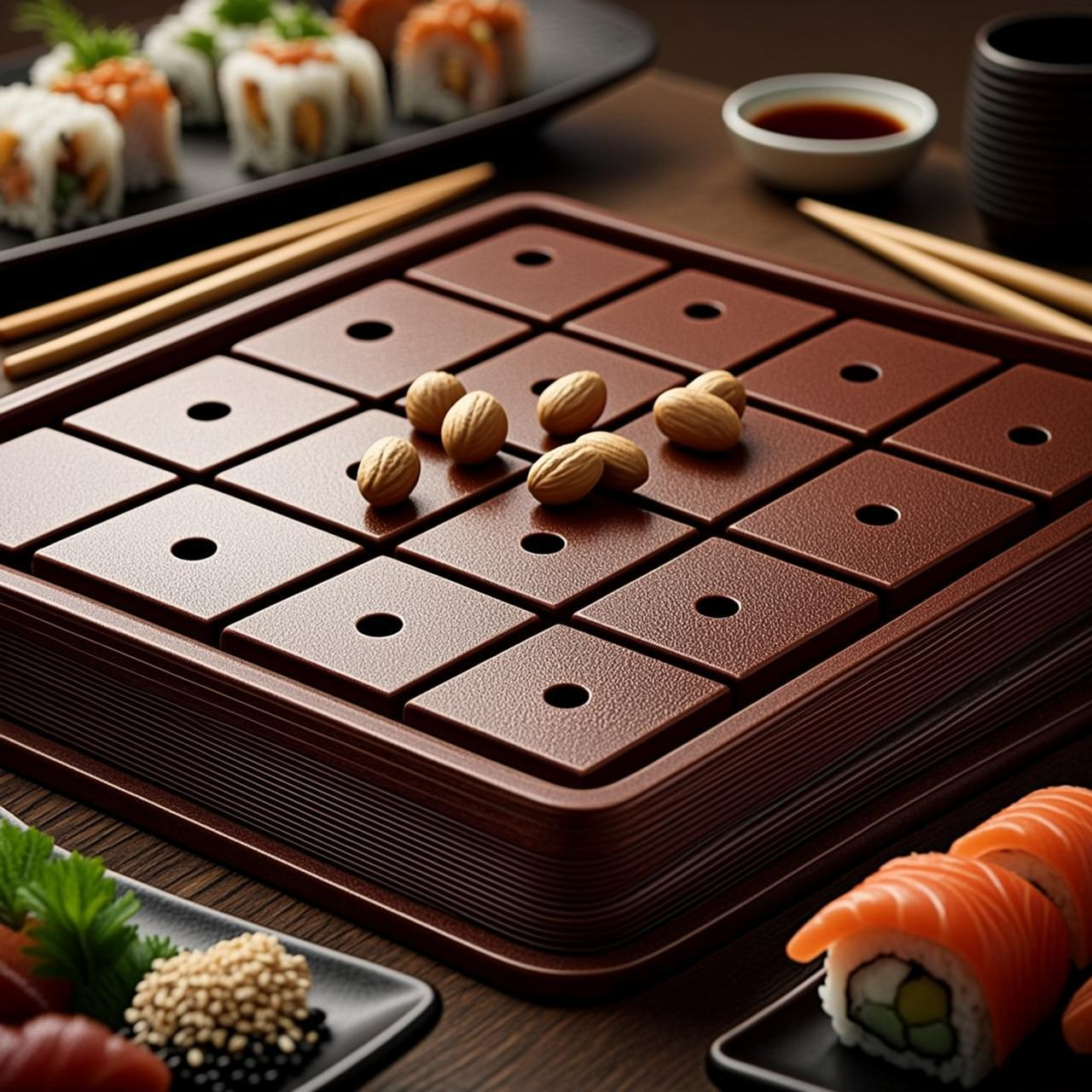
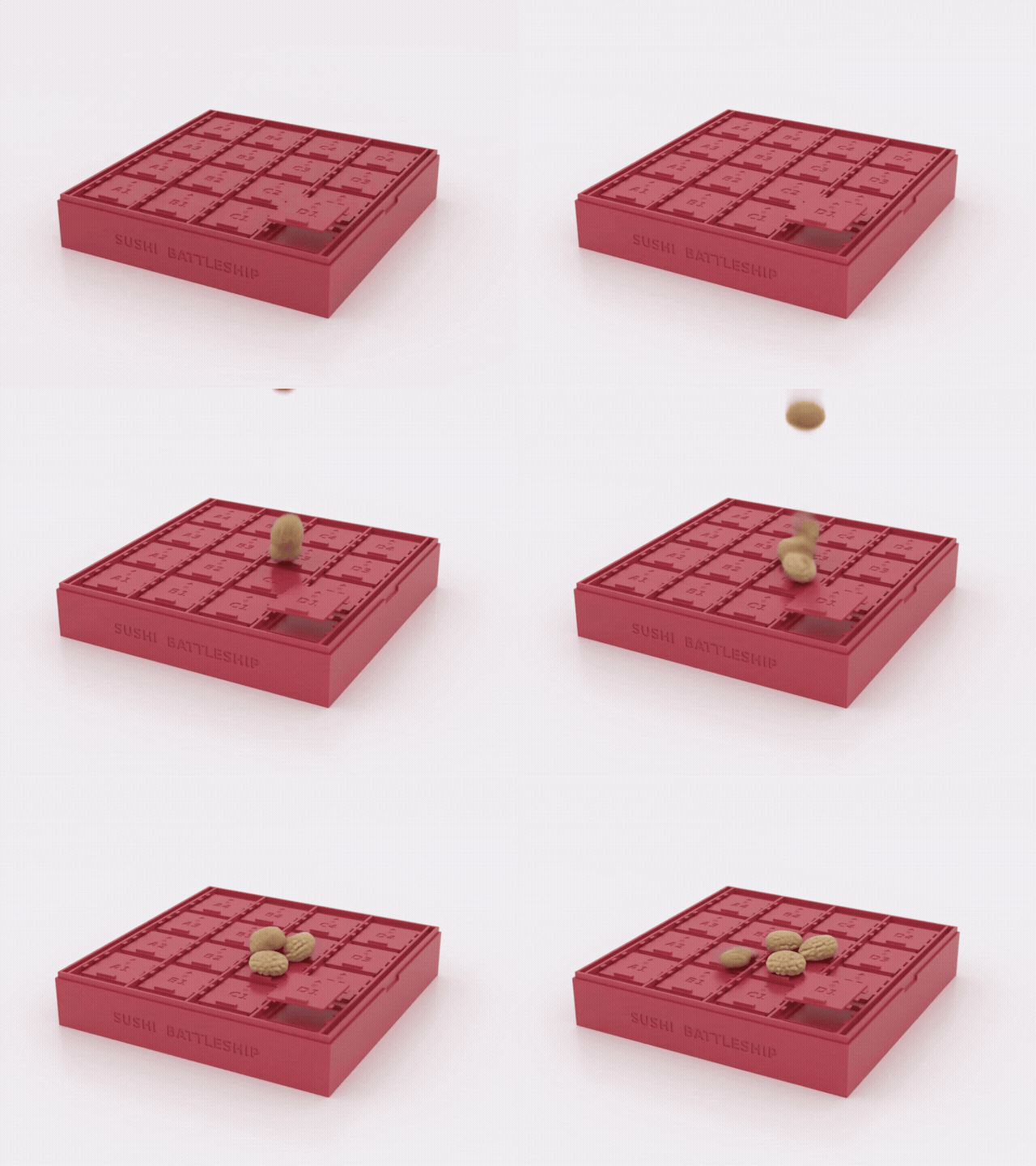
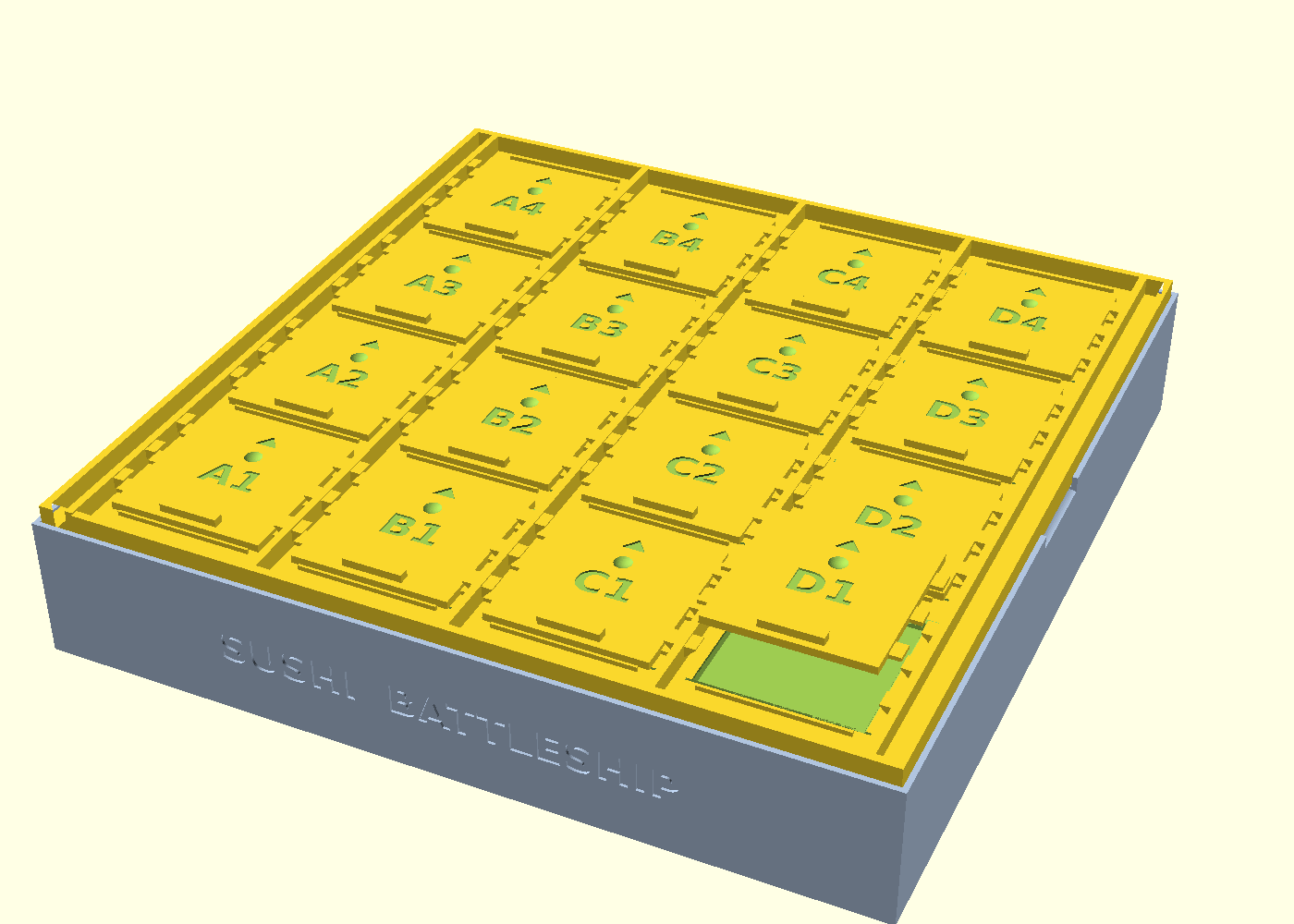
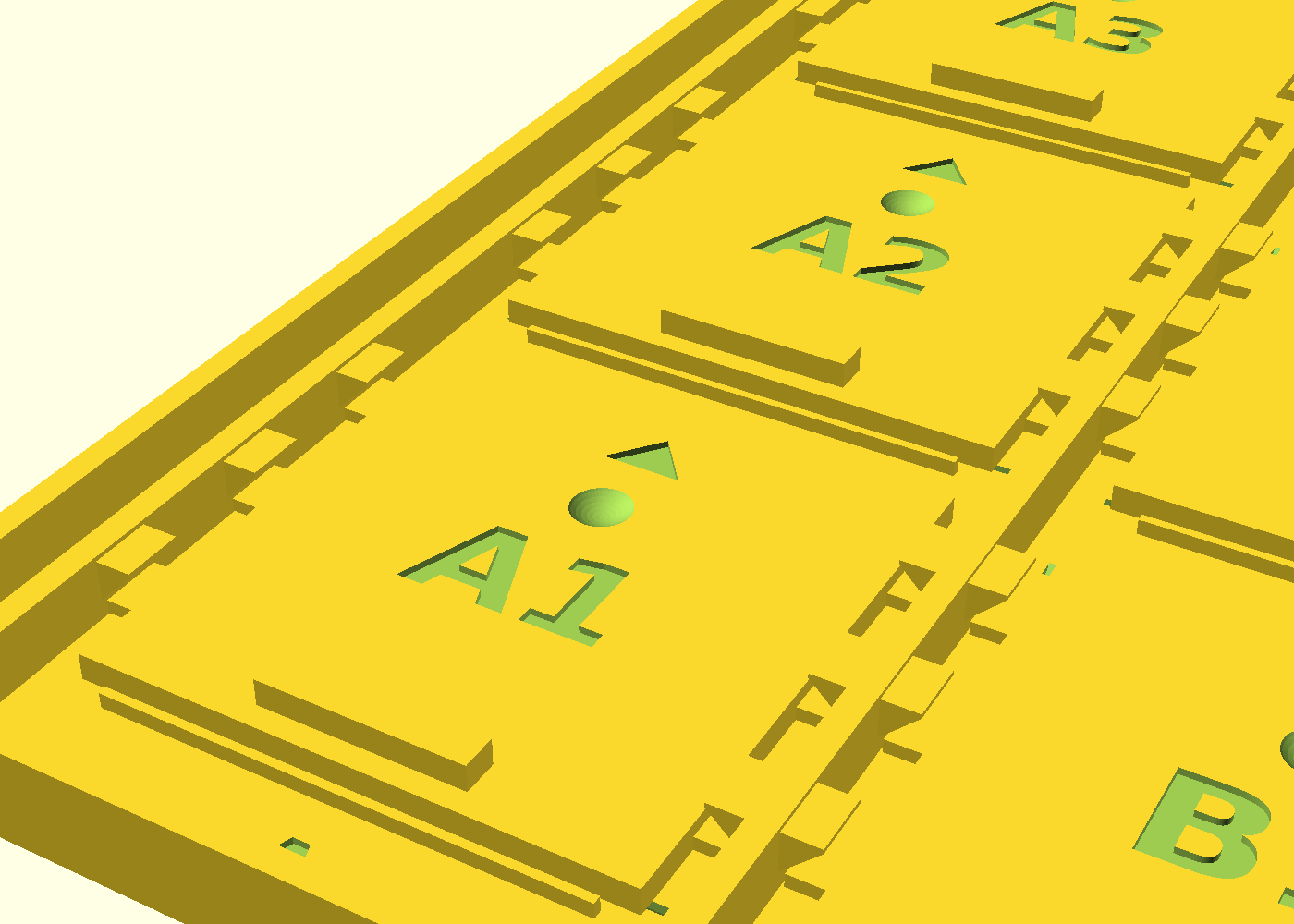
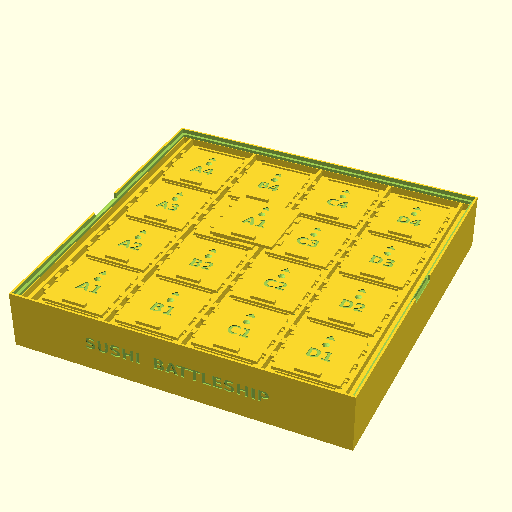
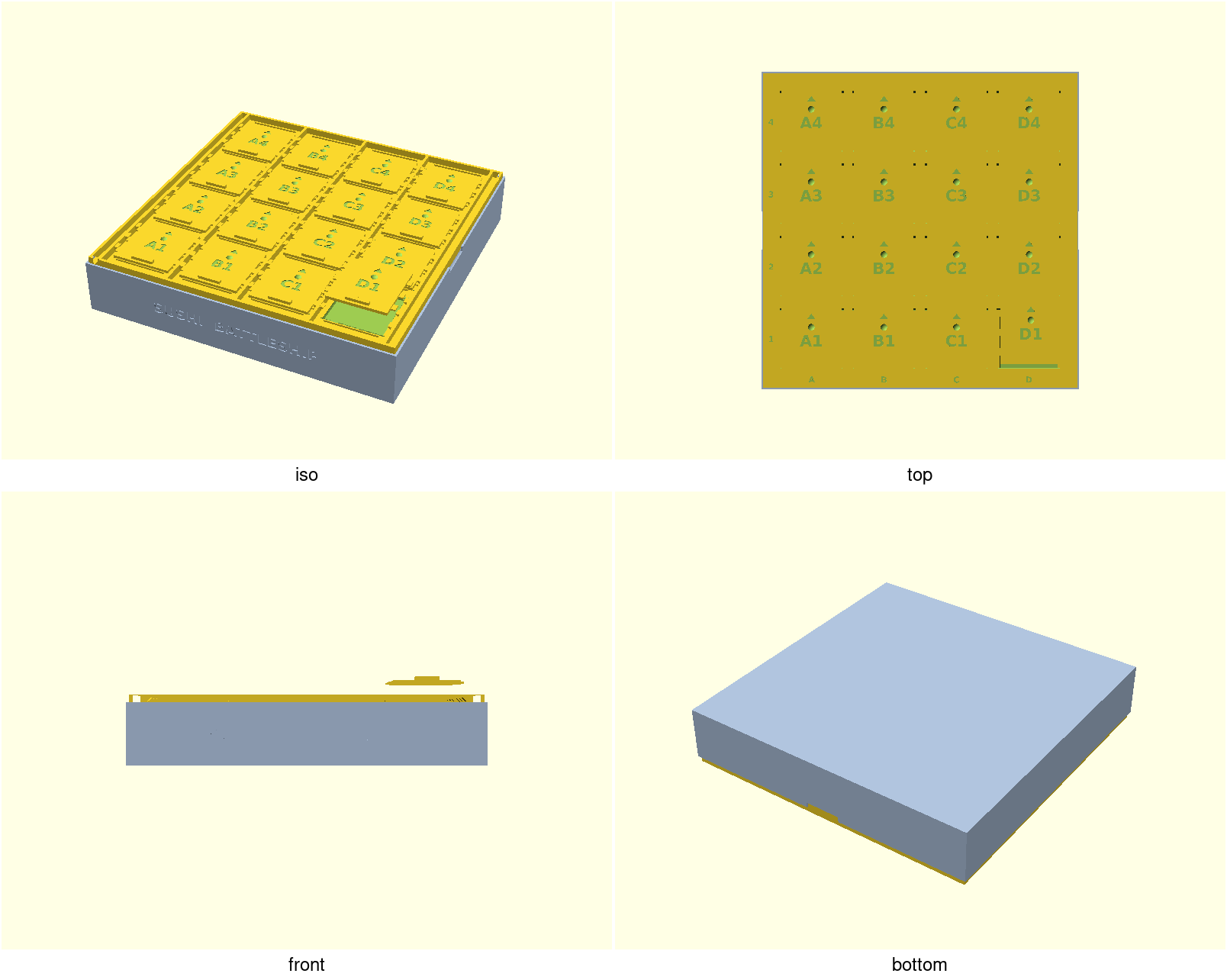
A shot-tracker refit of Sushi Battleship: the same two-part board for playing battleship with real sushi, with one addition — every sliding shutter door now carries a shallow dished miss-marker seat. Park a small round marker (a dried soybean, a 6 mm BB, a peppercorn) on any cell that has been called, and nobody re-calls B3 three bites later. For anyone who printed (or wants) the original and plays it slowly enough to lose track of called shots — which is everyone eating dinner off it.
This is a derivative of the archived
sushi-battleship (frozen at v0.1): its entry .scad
includes the parent verbatim and redefines only the shutter door. Everything
not described here — the tray, the print-in-place shutter mechanism, the
membranes, the whole game — is documented once, on the
parent's page.
What you get
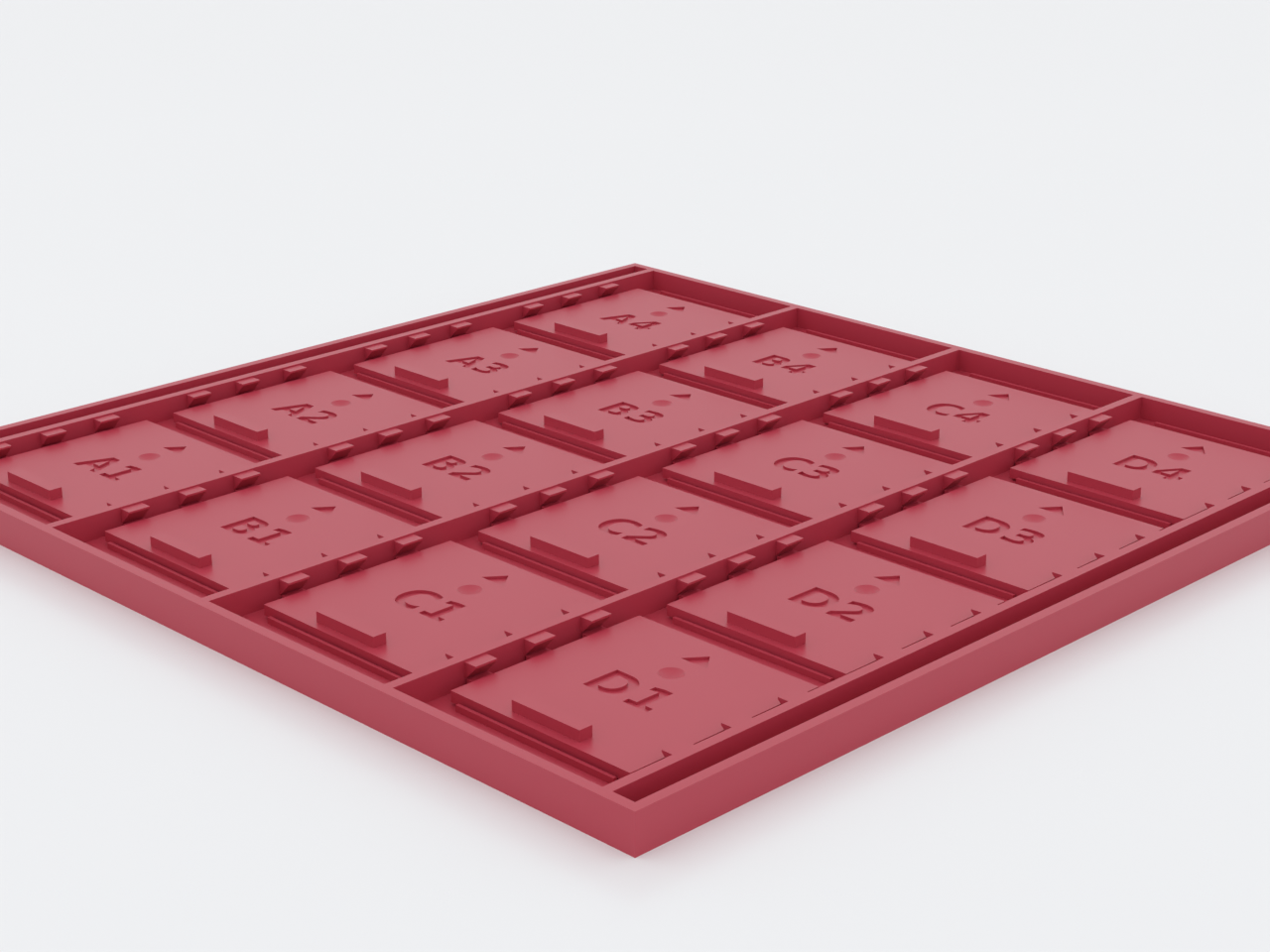
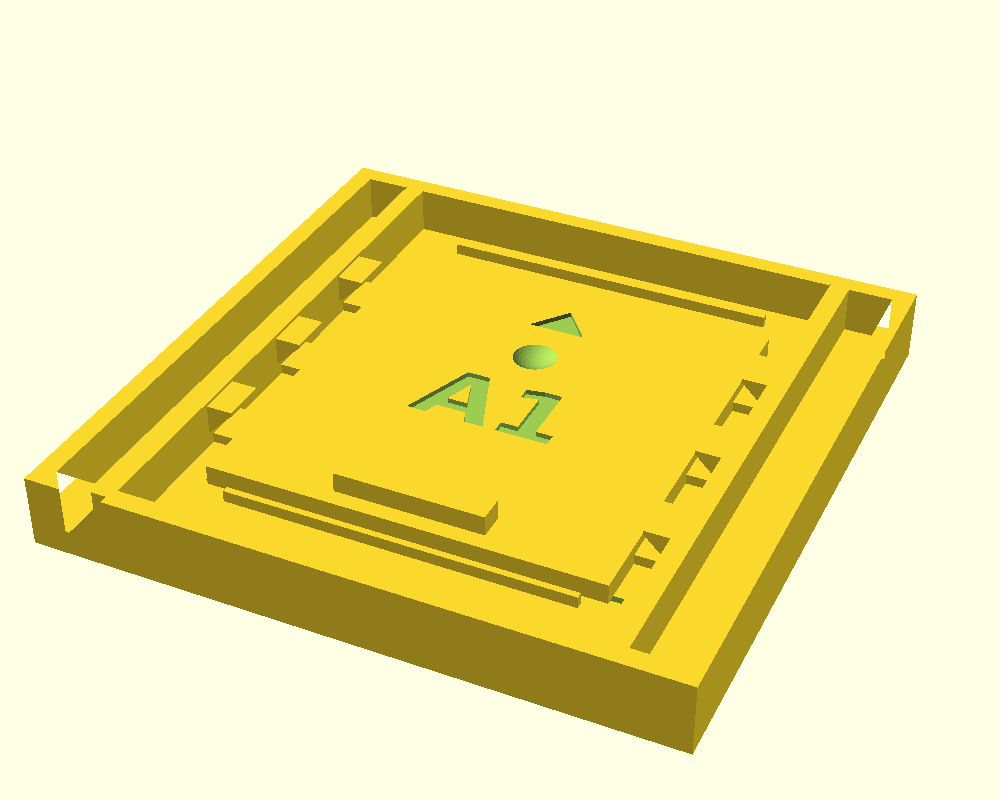
bottom— the parent's tray, unchanged (≈ 254 × 254 × 44 mm; 4×4 cells for cut sushi-roll pieces)top— the print-in-place lid, all 16 shutters captive, each with a marker seat (≈ 250 × 250 × 9 mm)door— one spare/tuning shutter with the seat (≈ 48 × 50 mm)sushi-battleship-tracker-coupon— single-cell "print this first" test piece for tuningdoor_fitand marker fit
Markers are not printed parts: any roughly-spherical 4–10 mm household
object works — set marker_d to match yours (dried soybeans are on
theme).
The delta
The seat is a spherical dish (Ø ~5.3 mm opening, 1.0 mm deep at the
defaults) cut into each door's top face between the coordinate engraving
and the push arrow. It adds zero height, changes no fit surface, and every
layer of the dish is wider than the one below it, so the print-in-place
scheme is untouched. A door_fit value tuned on the parent's coupon
carries over as-is.
Print settings
Identical to the parent — the refit moves no printable surface except the door's top face:
- Material: PLA or PETG
- Layer height: 0.2 mm (membranes are quantized to it — see the parent's notes)
- Infill: 10–15 %
- Supports: none needed (the seat dish is self-supporting)
- Orientation: both parts flat as exported; the top prints with all doors captive in place
- Print first: the coupon — tune
door_fitand drop your marker in the seat before committing to the full board
Parameters
The refit's own knobs, plus the one inherited parameter you are most likely to touch:
| Parameter | Default | What it does |
|---|---|---|
marker_d | 8 mm | diameter of the marker the seat is dished for; asserted to the practical 4–10 mm range (peppercorn ~4–5, BB 6, soybean ~7–9) |
seat_depth | 1.0 mm | how deep the seat is dished; coupled to marker_d by asserts — it must stay below the marker radius, leave ≥ 1.2 mm of door floor, and keep the seat rim ≥ 0.8 mm clear of the engravings |
door_fit | 0 mm | inherited from the parent: door-only fit tuning in ±0.1 steps |
Everything else — grid size, roll diameter, clearances — is the parent's
parameter set, inherited unchanged; see the top of
sushi-battleship.scad.
Override on the command line with -D 'marker_d=6'.
Assembly & use
Two printed halves, no hardware: the lid drops onto the tray and
self-aligns to the grid. The full bill of materials and step-by-step
assembly are in ASSEMBLY.md.
Play exactly as the parent describes. The one new rule: when a shot is called and misses, the defender parks a marker in the called door's seat. An open door is a hit, a marked door is a spent miss, an unmarked closed door is fair game. The seat is identical on all 16 doors, so markers leak nothing about where the sushi fleet actually is.